
Key takeaways
- One 52-card deck, three cards each, 3–7 players.
- Not looking costs 1 to 2 stakes per bet; looking raises that to 2 to 4.
- Side shows need two seen players; the final show needs exactly two players left.
- Dead-even hands normally go against whoever called the show.
The Setup: Deck, Players and Boot
Teen Patti is played with one standard 52-card deck and no jokers (wild cards only appear in variations). Aces are high, except in the A-2-3 run. The game works with 3 to 7 players; most apps seat 5.
Before the deal, every player puts the boot into the pot. The boot is a small fixed amount that guarantees there's always something to win. It also sets the opening stake: the amount the first player has to match.
Cards go out one by one around the table until everyone has three, all face down. Whoever sits on the dealer's left acts first, and the turn moves clockwise from there.
Blind vs Seen: The Rule That Makes Teen Patti Different
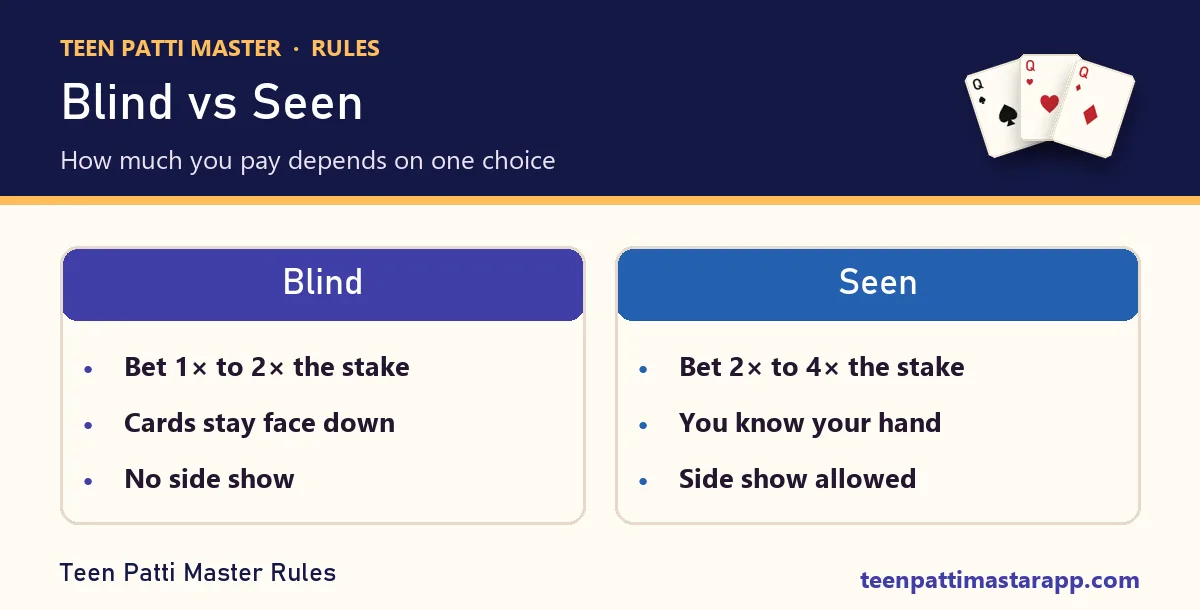
You don't have to look at your cards. A player who hasn't looked is blind; a player who has looked is seen (also called chaal or "playing seen"). This choice decides how much you pay.
| Blind player | Seen player | |
|---|---|---|
| Minimum bet | 1× the current stake | 2× the current stake |
| Maximum bet | 2× the current stake | 4× the current stake |
| Allowed to request a private comparison (side show)? | No | Yes |
| Can see cards later? | Yes, at any of your turns | Already seen |
The "current stake" is what the last blind player bet, or half of what the last seen player bet. Apps calculate this for you and only offer legal amounts, so in practice you'll see two buttons: the minimum and the doubled amount.
Why would anyone play blind? Because it's half the price, and because the other players have no idea what you hold. A blind player who keeps raising puts real pressure on the table.
What You Can Do on Your Turn
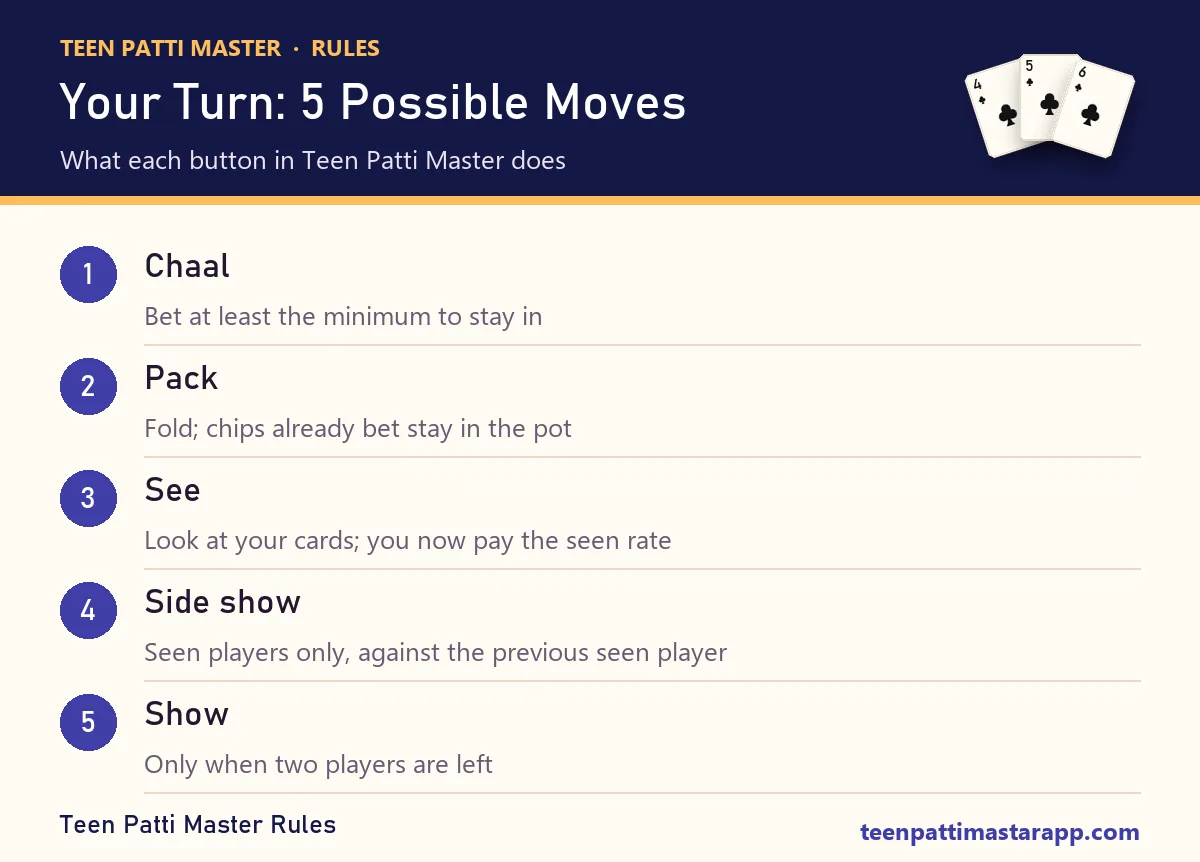
- Chaal (bet): put in at least the minimum to stay in the round. Raising up to the maximum lifts the stake for everyone after you.
- Pack (fold): drop your cards and sit the rest of the round out. Chips you've put in are not refunded.
- See your cards: if you're blind, you can look at any turn. From then on you bet at the seen rate.
- Side show: available only when you and the player before you are both seen (details below).
- Show: the final face-up reveal, which unlocks once the table is down to two.
The Side Show
Think of a side show as a quiet duel. When it's your turn and you've looked at your cards, you put in your bet and invite the seen player just before you to compare hands where nobody else can see. They're free to say no.
- If they accept, the two compare cards privately. The weaker hand must pack. If the hands are exactly equal, the player who asked usually packs.
- If they refuse, play simply continues.
Side shows don't exist with only two players left (that's what the show is for), and many apps don't allow them while any blind player is still in the round. House rules vary here more than anywhere else, so check the rules screen of the app you use.
The Show and Who Wins
When everyone except two players has packed, either of the two can pay for a show. Both hands are turned face up and the higher one under the hand rankings takes the whole pot.
- If both players are seen, the player asking pays the seen rate.
- If you're still blind, your show costs only the blind rate. The reverse doesn't work in most rule sets: having looked doesn't let you drag a blind opponent into a show.
- If everyone else packs before a show, the last player standing wins without revealing their cards.
Ties and Tie-Breaks
Hands of the same type are compared card by card:
- Trail: higher rank wins (A♠ A♥ A♦ beats K♠ K♥ K♣).
- Sequences: A-K-Q is highest, A-2-3 second in most Indian house rules, then K-Q-J and down to 4-3-2. Some groups count A-2-3 as the lowest run, so agree on it first.
- Color and High Card: line both hands up from the top card down; the first card that differs settles it.
- Pair: the higher pair wins; if pairs are equal, the higher odd card wins.
Suits never break ties in standard rules. If two hands are identical in rank (for example Q♠ 9♠ 4♠ and Q♥ 9♥ 4♥), the player who asked for the show loses. Some apps split the pot instead.
Pot Limits and Blind Limits
Most tables set a pot limit. When the pot reaches it, betting stops and there's an automatic show among the players still in. Many apps also limit how many rounds of betting you can play blind (often four), after which you have to see your cards. These limits stop a round from going on forever and cap how much any one hand can cost.
House Rules vs App Rules
At a family table, rules are whatever the group agrees on. In an app, the rules are fixed by the software and shown on a help or "rules" screen. The usual differences are the A-2-3 ranking, whether blind players can be part of a side show, and the pot limit. Read that screen once before playing, and you'll avoid most "I should have won that!" moments.
Frequently Asked Questions
Why is the game called Teen Patti?
It's Hindi for "three cards", which is exactly what each player holds for the whole round. There's no drawing or swapping.
Why do seen players in Teen Patti Master pay twice as much?
Looking at your cards is an advantage the blind players don't have. The doubled price is what that knowledge costs.
I'm still blind. Am I allowed to request a side show?
Not under standard rules. You have to look at your cards first, and even then you can only ask the seen player sitting just before you.
Who wins a show when both hands are identical?
Old-school rules hand the pot to the player who didn't ask for the show. Plenty of apps split it down the middle instead, so a quick look at the rules screen saves an argument.
Is A-2-3 a high or low sequence?
In most Indian games it's the second-highest run, just below A-K-Q. Some groups treat it as the lowest. Agree before you start.